Skip to content

Research

Research

I’m most interested in questions where a model’s output isn’t enough to tell you whether the model is actually behaving well.

Right now, that mainly pulls me toward model interpretability, representation learning, optimization dynamics, and robustness.

I also like applied research when the statistical question matters as much as the predictive one.

Undergraduate thesis

Benchmarking Vision Transformers Against CNNs for Plant Disease Diagnosis

It started as PlantGuard, a hackathon project, and became my thesis: do architectures that reach similar accuracy learn the same things along the way?

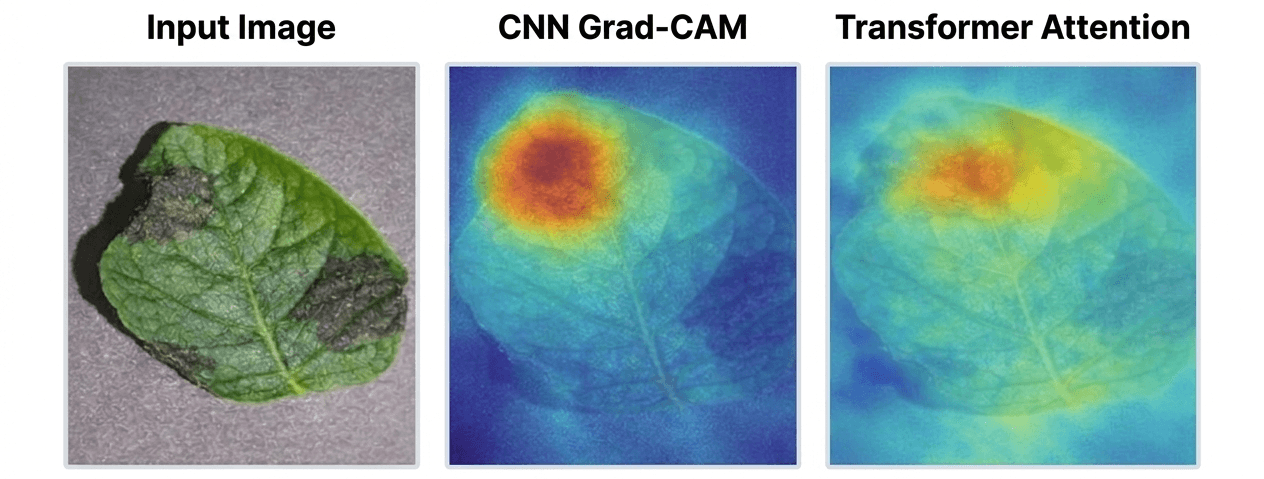
Inside a controlled pipeline, ResNet-50 and ViT-B/16 land within about a point of each other, yet their attribution maps diverge sharply: the CNN concentrates on lesions, the ViT reads the whole leaf. I quantified the gap with saliency entropy, attribution concentration and lesion overlap across 1,100 test images.

Advised by Dr. Chiranjib Sur and Dr. Shyam Kumar Sudhakar.

Read the thesis (PDF)
Questions I keep coming back to

  • Q1

    When two models agree, are they reasoning the same way?

    Interpretability, representations, CNNs, Vision Transformers.

  • Q2

    How do you turn a messy real-world problem into something an optimizer can solve?

    Constraint programming, integer programming, scheduling, heuristics.

  • Q3

    Where should an AI agent have autonomy, and where should it stop?

    Tool use, context systems, workflow automation, evaluation.

  • Q4

    How much engineering does it take before an ML idea becomes genuinely useful?

    Retrieval, latency, APIs, data pipelines, deployment.

Research projects

01 · Undergraduate Thesis · Computer Vision

How do CNNs and Vision Transformers actually arrive at a diagnosis?

Benchmarking Vision Transformers Against CNNs for Plant Disease Diagnosis: Performance, Robustness, and Visual Interpretability

Two models can reach similar accuracy while learning very different representations.

My undergraduate thesis is a computer vision study comparing ResNet-50 and ViT-B/16 inside a controlled three-stage pipeline (leaf localization, species classification, species-conditioned disease prediction) on roughly 54,000 leaf images across 13 species and 38 classes.

  1. YOLO leaf localization
  2. Species classifier
  3. ResNet-50 vs. ViT-B/16
  4. Grad-CAM · attention rollout
A diseased potato leaf beside the CNN's Grad-CAM map, concentrated on one lesion, and the transformer's attention map, spread across the leaf.
Same leaf, different evidence: CNN Grad-CAM vs. ViT attention.

Evidence

  • ViT-B/16 beat ResNet-50 at every stage: 93.8% vs. 92.7% on disease classification, 90.6% vs. 89.4% end to end.
  • ViT attribution maps were 1.83 nats more diffuse (saliency entropy 5.67 vs. 3.84, p < 0.001, n = 1,100).
  • The CNN put 71% of its attribution mass in the top 10% of pixels, against 49% for the ViT, and overlapped lesions more (IoU 0.61 vs. 0.44).
PyTorchCNNsVision TransformersYOLOGrad-CAMAttention RolloutInterpretabilityRepresentation LearningHPC

02 · Optimization · Deep Learning · NLP

Same accuracy. Different optimization story.

AdamW vs Muon · A controlled optimizer study on BERT-small

I fine-tuned BERT-small with AdamW and hybrid Muon expecting a straightforward optimizer comparison.

The accuracies tied.

  1. BERT-small · SST-2
  2. AdamW vs hybrid Muon
  3. 3 paired seeds
  4. Calibration · updates · sharpness

Evidence

  • Validation accuracy effectively tied: AdamW 88.57% ± 0.18, hybrid Muon 88.69% ± 0.93 over three paired seeds.
  • Muon reached rolling training loss 0.10 in about 38% fewer optimizer steps; AdamW had lower final validation cross-entropy and less seed variance.
  • At matched training loss (seed 1), Muon was less sensitive to random and projected-gradient perturbations, under the chosen parameterization.
OptimizationPyTorchBERTMuonAdamWLoss Landscapes

03 · Applied ML · Statistical Modeling

Can social support change how childhood adversity translates into mental-health risk?

Modeling the Impact of Adverse Childhood Experiences on Mental Health Risk in University Students

This project started with a dataset of 404 university students and a question that couldn’t be answered well by a single predictive model.

I used structural equation modeling, logistic regression, and random forests to study the relationship between adverse childhood experiences and mental-health outcomes.

  1. 404 student responses
  2. Structural equation model
  3. Logistic regression · random forests
  4. Mediation

Evidence

  • Dataset of 404 university students.
  • Structural equation modeling alongside logistic regression and random forests.
  • Social support appeared as a significant mediator, replicating the original study’s finding.
Structural Equation ModelingLogistic RegressionRandom ForestsApplied StatisticsResearch