Skip to content
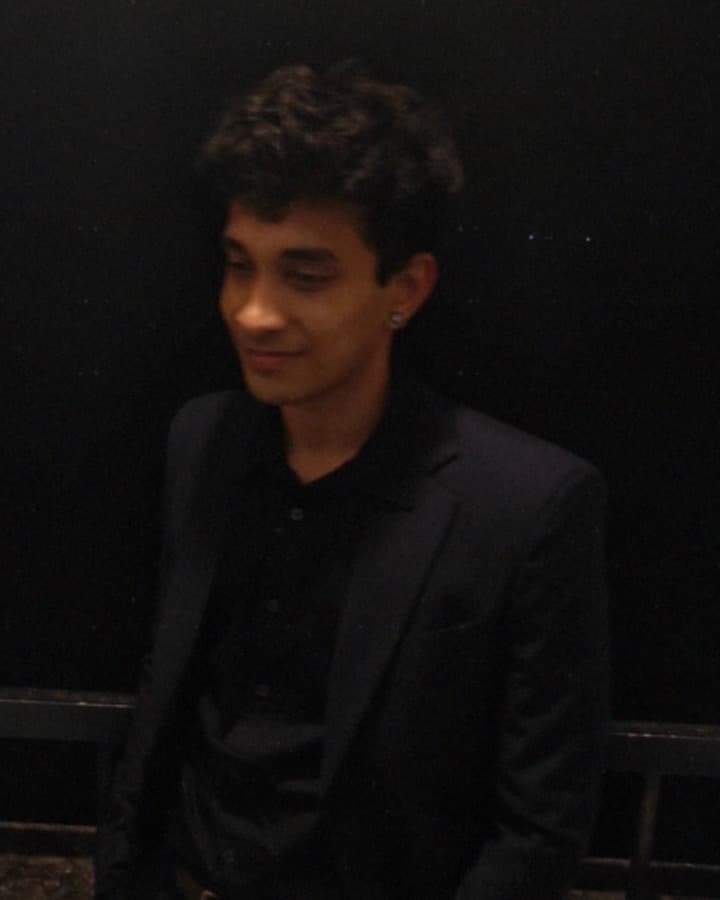
Vatsalya Betala in a dark blazer, smiling and looking off to the side, against a night-time background.

CS × Mathematics · AI / ML · Optimization

VatsalyaBetala

I build intelligent systems and try to understand why they work.

I’m the kind of person who gets stuck on the “why” after something already works.

If two models get the same accuracy, I want to know what they learned differently. If a scheduling system works on paper, I want to know what happens when you throw real people, real constraints, and real chaos at it.

That’s basically where most of my work lives: somewhere between understanding a system deeply and trying to make it useful outside a notebook.

Sometimes that means CNNs, ViTs, representations, and optimization.

Sometimes it means university timetables, warehouse systems, LLMs, agents, and a lot of messy engineering.

I like both.

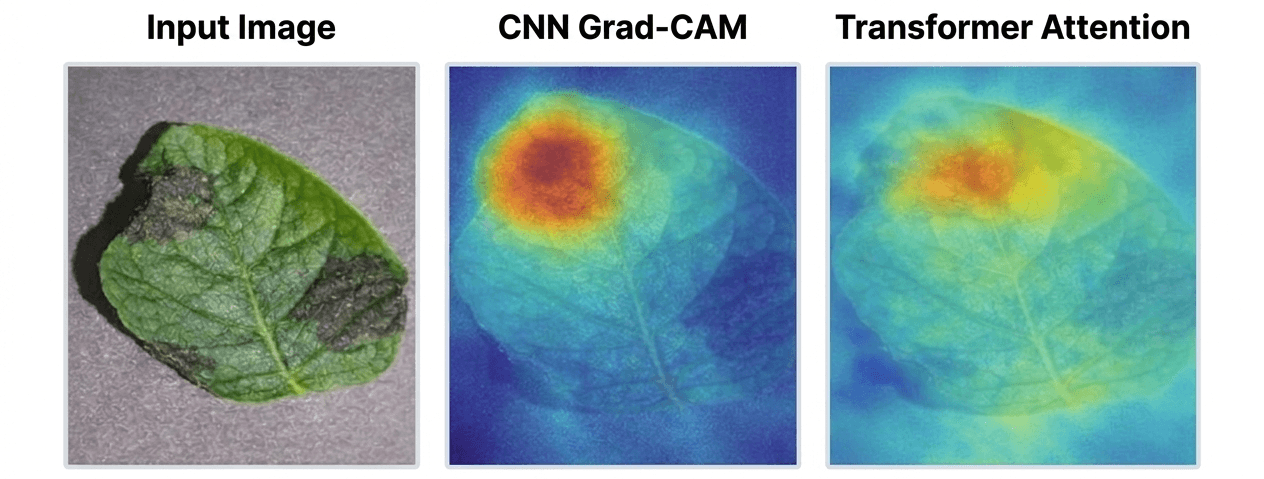
grad-cam(leaf.jpg)class: diseased
Where is the model looking?drag across it
Based in
New York, NY
Now
M.S. Artificial Intelligence, Columbia
Focus
ML · Optimization · Intelligent systems

Agent · retrieval over this portfolio

Ask my portfolio

You don’t have to read every page.

Ask about a project, a technical area, or what I’ve actually done in practice. The portfolio will search through my work and surface the most relevant evidence.

Suggested questions

About

Research when the question is interesting. Engineering when the answer needs to work.

I tend to gravitate toward problems where there is more going on than simply training a model and reporting an accuracy number.

In computer vision, that has meant studying whether CNNs and Vision Transformers arrive at similar predictions for the same reasons. In optimization, it has meant turning scheduling constraints into a system that could actually be deployed at a university. In industry, it has meant building interfaces around LLMs, operational data, and automation so that people can get useful answers without having to understand the machinery underneath.

The common thread is fairly simple: I like understanding complicated systems, then making them more useful.

Work

Selected work

A mix of research, optimization, and systems I’ve spent enough time with to have opinions about.
All work

01 · Undergraduate Thesis · Computer Vision

How do CNNs and Vision Transformers actually arrive at a diagnosis?

Benchmarking Vision Transformers Against CNNs for Plant Disease Diagnosis: Performance, Robustness, and Visual Interpretability

Two models can reach similar accuracy while learning very different representations.

My undergraduate thesis is a computer vision study comparing ResNet-50 and ViT-B/16 inside a controlled three-stage pipeline (leaf localization, species classification, species-conditioned disease prediction) on roughly 54,000 leaf images across 13 species and 38 classes.

  1. YOLO leaf localization
  2. Species classifier
  3. ResNet-50 vs. ViT-B/16
  4. Grad-CAM · attention rollout
A diseased potato leaf beside the CNN's Grad-CAM map, concentrated on one lesion, and the transformer's attention map, spread across the leaf.
Same leaf, different evidence: CNN Grad-CAM vs. ViT attention.

Evidence

  • ViT-B/16 beat ResNet-50 at every stage: 93.8% vs. 92.7% on disease classification, 90.6% vs. 89.4% end to end.
  • ViT attribution maps were 1.83 nats more diffuse (saliency entropy 5.67 vs. 3.84, p < 0.001, n = 1,100).
  • The CNN put 71% of its attribution mass in the top 10% of pixels, against 49% for the ViT, and overlapped lesions more (IoU 0.61 vs. 0.44).
PyTorchCNNsVision TransformersYOLOGrad-CAMAttention RolloutInterpretabilityRepresentation LearningHPC

02 · Optimization · Constraint Programming · Systems

Scheduling is easy until everyone has constraints.

OurClock · Constraint-based university timetable scheduling system

OurClock started as a university software-design project and somehow turned into a multi-year scheduling system used to generate real academic timetables.

The hard part was never putting courses into time slots. It was turning hundreds of small institutional rules into constraints a solver could actually reason about.

  1. Administrative inputs
  2. Constraint model
  3. OR-Tools · CP-SAT
  4. Validated timetable

Evidence

  • Deployed at Krea University across multiple terms, at the scale of 300+ courses.
  • Pilot testing reduced scheduling conflicts by 95%.
  • Valued at ₹50,000 at Krea; institutional contract discussions with IFMR College, Sri City.
Google OR-ToolsCP-SATInteger ProgrammingConstraint ProgrammingFastAPIMariaDBPython

AdamW vs Muon · Optimization · Deep Learning · NLP

Same accuracy. Different optimization story.

I fine-tuned BERT-small with AdamW and hybrid Muon expecting a straightforward optimizer comparison.

The accuracies tied.

So I started looking at convergence, calibration, update geometry, and sharpness instead.

OptimizationPyTorchBERTMuonAdamWLoss Landscapes
GitHub (opens in a new tab)

ACEs and mental-health risk · Applied ML · Statistical Modeling

Can social support change how childhood adversity translates into mental-health risk?

This project started with a dataset of 404 university students and a question that couldn’t be answered well by a single predictive model.

I used structural equation modeling, logistic regression, and random forests to study the relationship between adverse childhood experiences and mental-health outcomes.

It was a replication of Watt et al. (2020), and one result held up: social support appeared as a significant mediator between childhood adversity and mental-health outcomes, as the original study found.

Structural Equation ModelingLogistic RegressionRandom ForestsApplied StatisticsResearch

Experience

Things I’ve worked on in the real world

Most of my industry work has involved a similar translation problem:

take something technically possible and turn it into something another person can actually use.

Full experience
  1. Apr 2026 – Present

    Skai Lama

    AI Chief of Staff Intern

    At Skai Lama, I’ve been working less on isolated AI features and more on the connective tissue around them.

    One project was a Universal Context Bot that lets the team query information spread across Notion, Slack, Trello, and Google Drive through a single natural-language interface using Claude Projects and MCP servers.

    ClaudeMCPn8nAgentsAutomationRAG / Context Systems
    Side quest: the n8n content engine
  2. May 2025 – Jul 2025

    Addverb

    AI Optimization Intern

    Warehouses are a good reminder that optimization becomes much more interesting once physical constraints enter the picture.

    At Addverb, I built an LLM-powered SQL interface so warehouse managers could ask operational questions in natural language rather than manually querying databases.

    OptimizationLLMsSQLWarehouse SystemsSchedulingSimulation
  3. Dec 2024 – Mar 2025

    LLMate

    Machine Learning Engineer Intern

    At LLMate, I worked on an NLP-driven marketing analytics system that combined more than 150,000 rows of data from Facebook Ads, Shopify, and Google Analytics.

    The goal was to make that data explorable through natural language rather than another dashboard full of filters.

    NLPRAGLLM Fine-tuningAnalyticsRetrieval
  4. Dec 2023 – Jun 2024

    Ques.AI

    Delhi, India · Hybrid

    AI Engineer Intern

    A lot of the work here was around turning raw media into something actually usable.

    I worked with OpenAI Whisper and Google Cloud NLP to build podcast features around transcription, sentiment analysis, and hashtag generation.

    OpenAI WhisperGoogle Cloud NLPMeta Graph APIREST APIsGPT
  5. May 2022 – Jul 2022

    Voiro Technologies

    Data Science & Product Intern

    This was one of my earliest chances to see how modeling choices connect to business decisions.

    I worked on lead scoring using XGBoost and PCA, and on automating advertising-inventory workflows.

    XGBoostPCAData ScienceAutomation

Research

Research

I’m most interested in questions where a model’s output isn’t enough to tell you whether the model is actually behaving well.

Right now, that mainly pulls me toward model interpretability, representation learning, optimization dynamics, and robustness.

I also like applied research when the statistical question matters as much as the predictive one.

Undergraduate thesis

Benchmarking Vision Transformers Against CNNs for Plant Disease Diagnosis

It started as PlantGuard, a hackathon project, and became my thesis: do architectures that reach similar accuracy learn the same things along the way?

Inside a controlled pipeline, ResNet-50 and ViT-B/16 land within about a point of each other, yet their attribution maps diverge sharply: the CNN concentrates on lesions, the ViT reads the whole leaf. I quantified the gap with saliency entropy, attribution concentration and lesion overlap across 1,100 test images.

Advised by Dr. Chiranjib Sur and Dr. Shyam Kumar Sudhakar.

Read the thesis (PDF)

Questions I keep coming back to

  • Q1

    When two models agree, are they reasoning the same way?

    Interpretability, representations, CNNs, Vision Transformers.

  • Q2

    How do you turn a messy real-world problem into something an optimizer can solve?

    Constraint programming, integer programming, scheduling, heuristics.

  • Q3

    Where should an AI agent have autonomy, and where should it stop?

    Tool use, context systems, workflow automation, evaluation.

  • Q4

    How much engineering does it take before an ML idea becomes genuinely useful?

    Retrieval, latency, APIs, data pipelines, deployment.

Skills

Tools I reach for

Grouped by what I use them for, rather than how many logos I can fit on a page.

Machine Learning

  • TensorFlow / Keras·
  • scikit-learn·

AI Systems

  • LangChain·

Optimization

Engineering / Data

  • Docker·
  • Data pipelines·
  • Logging & monitoring·

Additional languages

  • JavaScript·
  • C·
  • R·
  • Haskell·
  • Racket·

Numbers show how many pieces of work use a skill. Select one to see them. Skills without a number aren't evidenced in a write-up here yet.

Experimental

Challenge my claims

Portfolios make claims. Pick one and the system checks it against the evidence here, and reports what is missing, not just what supports it.

  • “Experienced in model interpretability”

  • “Builds systems people actually use”

  • “Optimization is real work, not a keyword”

  • “Builds agentic AI systems”

Off the clock

The parts that don’t fit on a resume.

A few things about me that have nothing to do with work.

fuel:
coffee
hands:
keyboard # the musical kind
weekends:
football
default_mode:
overthink
good_enough:
rarely
reading:
[psychology, nutrition]
favourite_hobby:
eating

$ status: somehow still functioning

I optimise things that really don’t need it.

maximize    everything
subject to  sanity ≥ 0
  • I will genuinely spend 20 minutes trying to save 30 seconds.
  • If I notice a better way to do something, I usually have to try it.
  • Very useful for projects. Slightly annoying everywhere else.

Coffee

Coffee first. Ideally one I brewed myself, because I love that part too.

That’s pretty much the whole section.

Keyboard

I play keys.

Mostly because sometimes I need to do something with my hands that isn’t typing.

Very picky.

  • If something feels off, I notice.
  • And if I know I can fix it, I usually find it very hard to leave it alone.
  • This applies to code, design, writing, and unfortunately a lot of other things too.

Eating vs. reading about eating

  1. I love food.
  2. I also somehow ended up reading a lot about nutrition.
  3. These two interests do not always get along.

Psychology

I read a lot of psychology because I find people interesting.

Sometimes I’m trying to understand other people.

Sometimes I’m very obviously trying to understand myself.

That’s honestly most of it.

Want to talk about something difficult?

Research, ML engineering, optimization, agentic systems, or an interesting problem that doesn’t fit neatly into one of those labels.